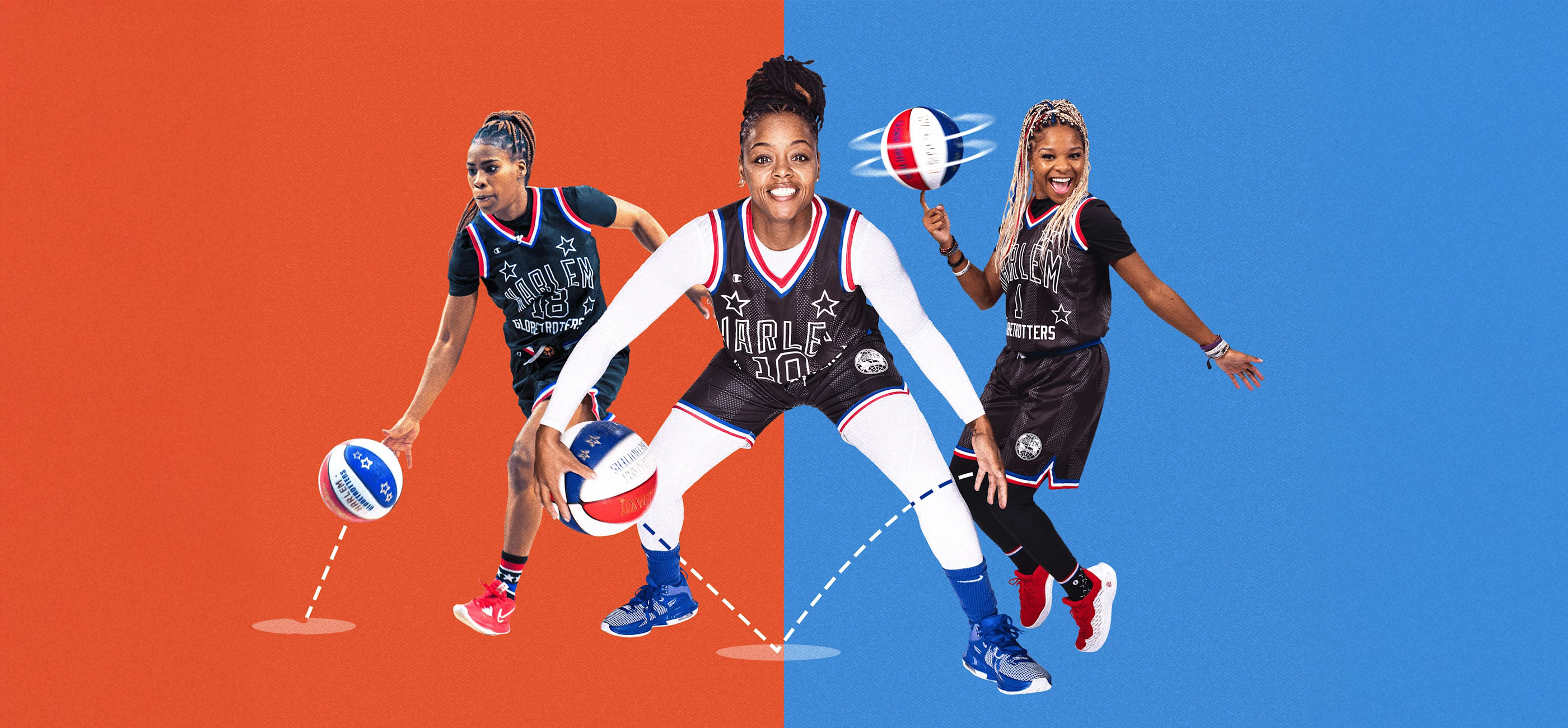
Meet TNT, Torch and Ace.
To cabdrivers or other chatty strangers, Fatima Lister is a librarian or a “hot-air-balloon instructor person.”
“I think it’s kind of fun,” she tells Yahoo of these temporary aliases. “But I usually end up telling them my real job.”
That job often elicits even more questions than a hot-air-balloon instructor might. Lister, known on the court as TNT, is a member of the Harlem Globetrotters. And when she tells people that, there’s one particular response that tends to follow: There’s a women’s Globetrotter team?
Or, sometimes, people will assume the women of the Globetrotters must work in ancillary roles elsewhere in the organization.
“‘Oh, you’re PR? You capture the content?’” That’s what strangers often ask Arysia “Ace” Porter when she tells them her job. “I’m like, ‘No, I play on the team.’ And they’ll be like, ‘Oh my God, I didn’t know they had an all-girls team!’” she says.
Cherelle “Torch” George knows these interactions well. She gets the same assumption about a women’s team when she mentions being a Globetrotter. “And I’m like, ‘No, it’s coed. There’s been women on the team since 1985,’” she says.
Yes, really. Women play professional basketball for the same Harlem Globetrotter team that once served as a traveling showcase for Fred “Curly” Neal and Meadowlark Lemon. The women play alongside men and against men. Starting with Lynette Woodard in 1985, there have been nearly 20 women to play for the Harlem Globetrotters — although, when Lister joined the team in 2011, she was the first woman to do so in almost two decades. Now, there are six women on the roster — a number that could increase following tryouts next month in Atlanta.
To the fans who come see them play year after year, this doesn’t come as a surprise. The women are hard to miss on the court. But if people haven’t been paying attention to the Globetrotters, finding out that the mom of two (Lister) or the 5-foot-3 “trick-shot queen” (George) or the ball girl for the San Antonio Spurs (Porter, who says only a “select few” NBA players know about her alter identity as Ace) also plays for the same Harlem Globetrotters as the men?
“Usually they’re shook,” Porter says.

‘We do just about everything that the guys do’
The Globetrotters are an exhibition, an entertainment product that is necessarily less competitive than the NBA or WNBA. But the athletes are still just that: athletes. In December, they’ll kick off a several-month tour for the 100th anniversary of the Harlem Globetrotters. They train for hours, play over 100 games a year and work to hone their physical craft on the court. That’s true of the men of the Globetrotters — and of the women.
The women don’t dunk, and they do emphasize their dribbling skills more than the men. “And other than that,” Porter says, “we do just about everything that the guys do.”
Because it’s not traditional basketball, they train not just to score but to showcase all the delightfully circuitous ways a ball can be transported from hands to hoop. George is especially ambitious about that aspect of the Globetrotters’ game. She says she’ll often get inspired by something she sees on social media, playing it over and over for hours — and then work to make it her own.
That flair is part of every Globetrotter’s play. But for the women in particular, it’s part of their physical presentation as well. Wherever the team goes, the court is a stage, and caring about your style is part of being a professional entertainer.
“A lot of times we’re on different units, and we’re the only woman on the court, and so that means you have a spotlight on you all game, whether you want it or not,” Lister says. “So I try to have a style that reflects who I am, and that would empower a little girl — whether she looks like me or not — to just be herself and be confident in herself and how she’s maneuvering.”
That means long hair, whether worn loose or in braids, nails manicured and makeup done. Porter sports stick-on face crystals to go with her multicolored braids and on-court dance moves. George prioritizes getting the jerseys tailored to fit her smaller frame and going bold with her accessories. She’ll mix and match different shoes at the same time because she’s learned that’s the kind of eye-catching detail that’ll delight kids who come to the games.
And, “Because I think as females, we’re always going to stand out. But I want to stand out stand out, you know?” George says.
Packing tips, parenting and ‘bodyguard brothers’
The women laugh when asked what it’s like having male teammates. The truth is, the guys are great, they say. When Lister joined in 2011, she was the only woman — not only on the court, but anywhere in the organization. She knew it would only work if there was real chemistry with her male teammates; if they accepted her, not as a gimmick but as a peer.
“I got really lucky with the vets that I had,” she says. Many of her male teammates have become close, lifelong friends. She calls them “bodyguard brothers.”
“They give us respect on the court and they stand next to us unapologetically and treat us as equals,” Lister says. “And I think that’s so important, not only with the Globetrotters, but just with the way women’s sports are evolving right now — our male counterparts standing with us as athletes.”
And yet, the reality is, it’s not the same. That’s why the growing cohort of women on the roster is so valuable — as role models to give young girls another option for how basketball could be a part of their professional future, and also to each other.
“I think it’s important for us ... that we pass on the knowledge and the experiences that we’ve had,” George says. “Like, the importance of packing tampons.”
Already, there’s institutional wisdom among the women on the team. That can manifest in the form of road trip tips. For example, err on the side of underpacking because when you’re in a different city every night, you don’t need a new look each time. (“So you can keep that one outfit and you can keep using it,” Lister says.)
But it also plays out in bigger ways as well.
“When she got pregnant, I wasn’t sure if she was going to be able to come back,” George says about Lister, who has a 7-year-old daughter and a 1-year-old son. “She’s the example to women who are coming in, or the women that are here that are inspired to be mothers while they’re still playing professional sports.”
Lister says she didn’t know what it would be like to go through pregnancy and postpartum as a professional athlete. It was all unknown before her daughter. She credits a team trainer with helping her return to playing shape — and her motivation to do something, in her own words, “that’s bigger than me.”
“It was important to me to go back, because I feel like it’s such a negative stigma for women in the workplace to have a child,” she says. “I wanted to be a part of the group that’s showing people that I can do both of these, and I can be great at both of these.”
“She can be a mother and hoop at the same time,” Porter says. “And cross these dudes up!”
For more information on licensing opportunities with the Harlem Globetrotters, visit https://imglicensing.com/brands/harlem-globetrotters/.


